Understanding Service Charges and Community Fees in Oman's Freehold Developments
September 26, 2026
Every price sheet for a freehold community in Oman quotes a purchase price, and buried further down — or sometimes only mentioned once you ask — is a second, recurring number: the annual service charge. It's easy to treat this as a minor administrative fee, but in an amenity-heavy waterfront community it can run into thousands of rials a year, materially affecting both your cost of ownership and your actual rental yield. Here's what it funds, how it's set, and what to check before you buy — and why it's one of the most consequential numbers on the entire price sheet, not a footnote to it.
What Service Charges Actually Fund
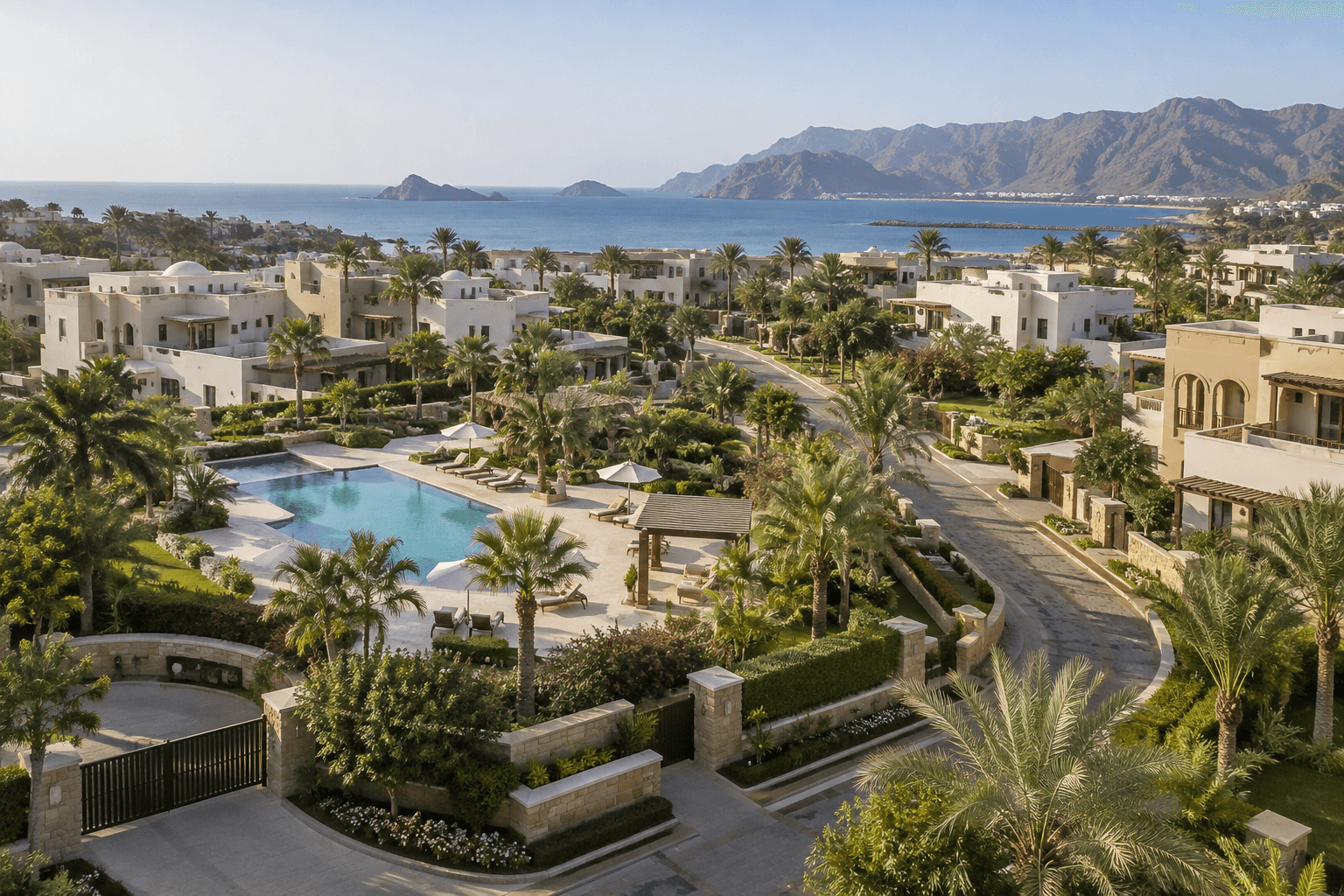
Service charges cover the ongoing cost of running everything shared across a community that isn't any single owner's individual responsibility: security staffing and access control, landscaping and irrigation, cleaning and upkeep of shared pools, gyms, and clubhouse facilities, and general maintenance of shared infrastructure like roads, lighting, and drainage within the development. In waterfront communities like Al Mouj or Muscat Bay, this also typically includes upkeep of the marina, beach areas, and any shared boardwalk or promenade — amenities that make the community desirable but cost real money to maintain to a high standard.
A well-run service charge budget also includes contributions to a sinking fund — money set aside for major, infrequent expenses like repainting building exteriors, replacing lift equipment, or resurfacing roads — rather than only covering day-to-day running costs. This is one of the more important, and least visible, things to check before buying, covered further down.
Insurance for the building's shared structure is sometimes bundled into the service charge as well, particularly in apartment towers — see our property insurance guide for how this interacts with, or sometimes replaces, an individual owner's own building policy.
How They're Calculated
Service charges are typically set per square metre of a unit's size and billed annually, calculated from the community's total operating budget for the year divided across all units in proportion to size. The master developer or the community's owners' association sets the rate, usually reviewing and adjusting it annually as actual costs change.
Rates can vary significantly between developments, and even between buildings within the same community — a building with a swimming pool, elevators, and a concierge desk will generally carry a higher per-square-metre charge than a simpler building in the same development without those features. Don't assume a single "service charge rate" applies uniformly across an entire community; ask for the specific rate tied to the specific building or unit you're considering.
Comparing Rates Across Communities
Because rates aren't standardized nationally, the only reliable way to compare service charges across two communities you're considering is to ask both management companies directly for the current per-square-metre rate and get it in writing, rather than relying on an agent's general impression of "roughly similar" fees. A gap of even a small amount per square metre compounds meaningfully over a full unit size and over a multi-year holding period.
It's also worth asking how the rate has moved over the past several years rather than looking only at today's figure — a community with a history of steep annual increases tells a different story than one with a stable, predictable rate, even if today's numbers happen to look similar.
Villa Communities vs Apartment Buildings
Villas typically carry lower service charges than apartment towers, since a standalone house has no shared lifts, lobbies, or building-wide mechanical systems to maintain — the charge in a villa community usually covers only the shared community infrastructure (roads, communal landscaping, a shared gate or security presence) rather than a building's own systems. Apartment buildings, by contrast, carry the cost of everything shared inside the structure itself on top of community-wide costs, which is why our villa vs apartment guide flags ongoing costs as a real factor in that comparison, not just the purchase price and rental demand.
This matters directly for net rental yield: two units at a similar purchase price and similar gross rent can produce meaningfully different net returns once service charges are factored in, and a villa's lower ongoing cost is a real, quantifiable advantage worth weighing against an apartment's typically higher gross yield in absolute terms.
Marina and Amenity-Heavy Communities Cost More to Run
The waterfront lifestyle that makes Al Mouj, Muscat Bay, and Jebel Sifah attractive to buyers is also, mechanically, the most expensive thing to maintain — a marina, a golf course, or extensive beachfront landscaping all carry real, ongoing upkeep costs that get passed through in the service charge. Buyers drawn to these communities specifically for the amenities should expect to pay for them accordingly through a higher annual charge than a comparable inland, amenity-light community would carry.
This isn't a reason to avoid these communities — the amenities genuinely add to both quality of life and resale desirability — but it's a cost that should be budgeted honestly from the outset rather than discovered as a surprise after your first annual invoice arrives.
Red Flags to Watch For
A few warning signs are worth specifically checking for before you buy into any community. Large year-on-year increases in the service charge rate, without a clear explanation tied to a specific new cost or capital project, can indicate a budget that was previously underpriced and is only now catching up to real costs — a pattern that may continue for several more years before stabilizing.
An underfunded sinking fund is a particularly common issue that only becomes visible at resale or when a major expense actually comes due — ask directly what the current sinking fund balance is and whether it's considered adequate against the building's age and expected major maintenance items, rather than assuming it's healthy simply because annual charges have been collected. Finally, ask whether the specific unit you're considering has any unpaid service charge dues attached to it — our inspection checklist guide covers this alongside the other documentation worth verifying before you sign.
What Happens if Charges Go Unpaid
Owners' associations generally have the right to pursue unpaid service charges through legal action, and in some communities unpaid dues can attach to the unit itself rather than only to the individual owner who incurred them — which is exactly why confirming a clean payment history before purchase matters as much as it does. A pattern of widespread non-payment across a community is also worth treating as a red flag in its own right, since it directly threatens the operating budget and can lead to deferred maintenance or a special one-off levy on all owners to cover the shortfall.
Budgeting for the Real Cost of Ownership
Service charges reduce net rental yield directly, and any return calculation that only accounts for gross rent against purchase price is incomplete — our rental yields guide covers realistic net figures by city and property type, which already factor in typical ongoing costs. When comparing two otherwise similar properties, always compare the all-in annual cost of ownership, not just the sale price, since a lower purchase price with a high service charge can end up costing more over a typical multi-year holding period than a higher purchase price with modest ongoing fees.
For buyers financing with a mortgage, remember that service charges are paid on top of your mortgage repayment, not instead of it — factor both into your monthly budget from the outset rather than only stress-testing the mortgage payment in isolation.
Questions to Ask Before You Buy
Before committing to a specific unit, get in writing: the current annual service charge rate per square metre for that specific building, the rate's history over the past three to five years, the current sinking fund balance and whether an independent reserve study has been done, and a copy of the owners' association's most recent annual budget and financial statement if one is available. A seller or agent unwilling or unable to provide straightforward answers to these questions is itself worth treating as a signal.
Foreign buyers coming from markets without mandatory community fees sometimes underestimate this cost simply because it is unfamiliar, while buyers coming from the UAE or other Gulf markets with established owners' association structures tend to know exactly what questions to ask — it is worth borrowing that habit regardless of where you are buying from. A short glossary helps too: the term "owners' association" in Oman generally refers to the body — sometimes run directly by the master developer, sometimes handed over to an elected owners' committee once a community reaches a certain occupancy level — responsible for setting and collecting these charges and contracting the actual facilities-management company that does the day-to-day work.
Service charges aren't a reason to avoid Oman's freehold communities — they're simply the mechanism by which shared amenities and infrastructure get maintained, the same as anywhere else in the world with community-managed developments. The point is to budget for them honestly and ask the right questions upfront, rather than treating the purchase price as the whole story. This guide is general information; always confirm current rates and fund status directly with the specific community's management before buying. Browse current listings or get in touch with questions about a specific development's fees.
More From the Blog

September 26, 2026
Jebel Sifah and Muscat Bay: Oman's Emerging Luxury Coastal Communities
Beyond Al Mouj and Muscat Hills, these two ITC-zoned marina communities south of the city are where a quieter, more resort-style buyer pool is looking.

September 26, 2026
Inheritance and Property Law in Oman for Foreign Owners
What happens to a freehold property in Oman if the owner passes away — and the estate planning steps that prevent it from becoming complicated for your family.

September 26, 2026
Short-Term Rental and Airbnb Regulations for Property Owners in Oman
Turning a freehold unit into a short-let earns strong khareef and tourism-season income — but only if it's licensed correctly. Here's the framework.