Duqm: Oman's Special Economic Zone and Its Real Estate Potential
September 26, 2026
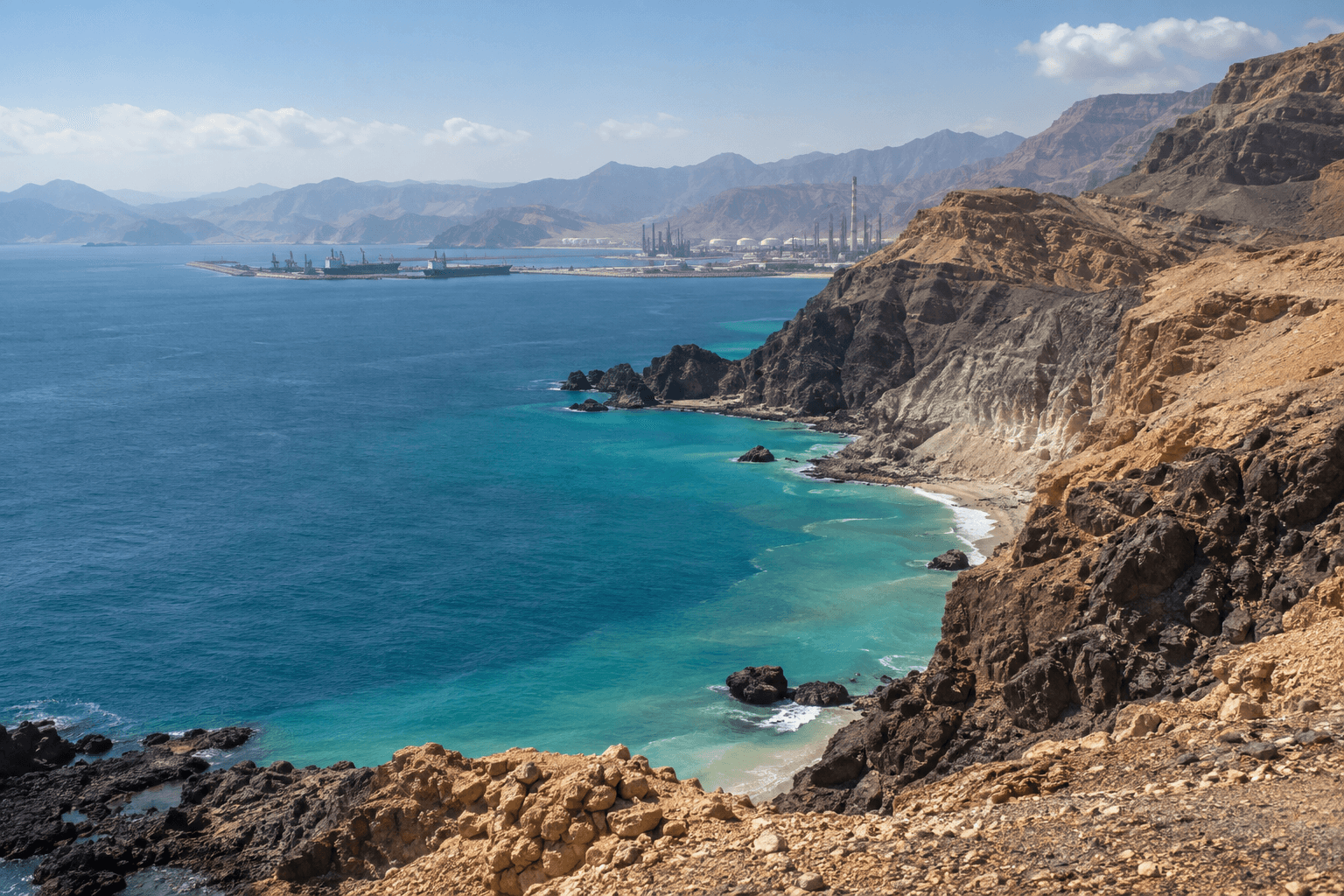
Twenty years ago, Duqm was a small fishing town on a remote stretch of Oman's central coast, roughly 550 kilometres south of Muscat. Today it is the site of one of the largest special economic zones in the Middle East — the Special Economic Zone Authority Duqm, or SEZAD — built around a new deep-water port, an oil refinery, a dry dock, and a master plan that stretches decades into the future. For property investors, Duqm is unlike anywhere else in Oman: not a lifestyle destination, not a tourism play in the way Salalah or Al Mouj are, but a genuine infrastructure-led city being built largely from scratch. That makes it one of the highest-potential and highest-patience real estate opportunities in the country, and one of the least understood by buyers used to Muscat's established freehold market.
What's Being Built at Duqm
SEZAD covers roughly 2,000 square kilometres — one of the largest such zones anywhere in the world — and its anchor projects are genuinely large-scale. Duqm Port is designed as a major regional hub for container, bulk, and break-bulk cargo, positioned outside the Strait of Hormuz as a strategic alternative route. Alongside it sits the Duqm Refinery, a joint venture between Oman and Kuwait (branded OQ8), processing crude into refined products for export. The Duqm Dry Dock handles ship repair and construction at a scale few facilities in the region can match, and a dedicated Duqm airport has been developed to support the workforce and, eventually, tourism ambitions for the zone's planned coastal tourism area.
Beyond the headline industrial assets, SEZAD's master plan sets aside dedicated zones for petrochemicals, logistics, fisheries, and — further down the timeline — tourism and residential development along the coast. It's this last category that matters most to a property buyer: much of what exists today serves the industrial and logistics side of the zone, with the residential and tourism zones still in earlier stages of build-out.
Government investment in the zone has been substantial and sustained over more than a decade, which is itself a signal worth weighing — this isn't a speculative private masterplan that could stall for lack of funding, but a state-backed strategic priority tied to Oman's broader economic diversification goals under Vision 2040.
The Investment Case — And Why It's a Long Horizon
Duqm is best understood as an early-stage infrastructure city rather than a mature market with established comparables. Property and land values here are tied far more to the completion timeline of SEZAD's anchor projects — the refinery ramping to full output, the port's cargo volumes growing, the dry dock's order book filling — than to existing rental demand or resale activity, which is thin compared to Muscat or even Salalah.
That's precisely the trade-off: higher potential upside than a mature market, because today's prices reflect a city that's still being built rather than one that's finished, but real risk that timelines slip or that specific projects underperform relative to plan — which is a genuine possibility with any large state-backed infrastructure programme anywhere in the world, not a Duqm-specific concern. Investors comfortable with early-stage development risk elsewhere (industrial land banking, frontier-market infrastructure plays) will recognize the shape of this opportunity; investors looking for a predictable, income-producing asset from day one generally should not start here.
How Duqm's Timeline Compares to Other Gulf Special Economic Zones
Duqm invites comparison to other large state-backed special economic zones in the region — Jazan in Saudi Arabia, or the early decades of Jebel Ali in the UAE, which took a generation to grow from a bet on infrastructure into a fully realized economic hub. That's a useful reference point for setting expectations: the zones that eventually succeed at this scale typically take fifteen to twenty-five years to mature from initial construction to a genuinely diversified, self-sustaining economy, not five. Duqm is still well within its first two decades of serious development.
None of this is a prediction that Duqm will follow the same trajectory — every zone's outcome depends on its own execution, capital discipline, and demand fundamentals — but it's the right timeframe to hold in mind when reading any marketing material that implies rapid near-term returns. A realistic Duqm thesis is built on a ten-to-twenty-year view, not a three-to-five-year one.
Land Plots vs Built Property
Much of what's actually transactable in Duqm today is land — freehold or long-leasehold plots zoned for industrial, logistics, or future residential use — rather than completed residential units ready to move into or rent out. That's a meaningfully different proposition from buying a finished villa or apartment in Muscat: a land purchase in Duqm is a bet on the surrounding infrastructure being completed and demand materializing around it, not an income-producing asset on day one.
Some built residential and mixed-use stock does exist and is growing — workforce accommodation tied to the construction and operational phases of the refinery, port, and dry dock, plus early residential and commercial units aimed at the people actually staffing these facilities. This segment behaves more like Sohar's workforce-housing market than like a lifestyle purchase: steady if unglamorous demand tied directly to employment at the anchor industrial sites.
Workforce Housing and Near-Term Demand
If there's a near-term, less speculative angle into Duqm, it's here. The refinery, port, and dry dock all require ongoing staffing — engineers, technicians, marine crew, and management — and that population needs somewhere to live now, not in fifteen years. Housing built or bought to serve this workforce segment behaves more like a conventional income property than a land-banking bet, with occupancy tied to the zone's current operational headcount rather than a future master-plan completion date.
The ceiling on this segment is lower than the long-run upside of a well-placed land plot, but so is the risk and the holding period. It's a reasonable entry point for an investor who wants real, near-term exposure to Duqm's growth story without committing to the full multi-decade land-banking thesis.
Who Should — and Shouldn't — Consider Duqm
Duqm suits investors comfortable with a genuinely long horizon: think in terms of a decade or more, not a two-to-three-year flip. It suits a land-banking mindset — buying a well-located plot ahead of infrastructure completion and being willing to hold through the build-out period — more than it suits someone looking for immediate rental yield. Corporates with an actual operational reason to be in the zone (logistics, manufacturing, marine services tied to the port or dry dock) are a different, more straightforward case: for them, Duqm land is a direct input to their business, not a speculative real estate position.
It's a poor fit for buyers who want rental income starting immediately, who want to use the property personally in the near term, or who need a liquid asset they could resell quickly if their plans change. Compare this honestly against Muscat's established freehold communities or even Salalah's Hawana community before committing — both offer a fundamentally different risk and liquidity profile, covered in our Al Mouj guide and Salalah areas guide.
Ownership Structure — Different From the ITC Framework
Duqm doesn't operate under the same Integrated Tourism Complex framework that governs foreign freehold ownership in Al Mouj, Muscat Hills, Muscat Bay, Jebel Sifah, or Hawana Salalah. SEZAD has its own dedicated legal and ownership framework for investors and businesses operating within the zone, with its own rules on land allocation, leasehold terms, and — where applicable — freehold sale for specific residential and tourism zones. This is a genuinely separate regime from the ITC rules covered in our freehold vs usufruct guide, and buyers should confirm the specific ownership terms directly with SEZAD or the relevant developer rather than assuming the ITC playbook applies.
This is also an area where working with someone who has specific, current SEZAD experience matters more than usual — general Oman real estate knowledge doesn't automatically transfer to the zone's particular rules, and getting this wrong at the outset is far costlier to unwind here than in an established freehold community with a deep secondary market.
Practical Steps Before Committing
Before putting money into Duqm, verify the zoning and ownership structure of the specific plot or unit directly with SEZAD rather than relying solely on a developer's marketing materials. Get a realistic, sourced timeline for the infrastructure your investment case depends on — port cargo volumes, refinery output, dry dock order books — rather than accepting an optimistic master-plan date at face value. And work with a licensed agent who can speak specifically to SEZAD transactions, since this is a narrower specialism than general Muscat or Salalah brokerage.
It's also worth physically visiting before committing capital, more so than almost anywhere else in Oman. Renders and master plans can make any early-stage zone look further along than it is; a site visit tells you plainly what's operational today versus what's still a plan on paper, and how far current construction actually reaches beyond the anchor industrial sites.
Duqm is not a market for every buyer, and it doesn't try to be — it's a long-horizon, infrastructure-led opportunity for investors who understand exactly what they're underwriting. This guide is general information based on publicly available details about SEZAD and the zone's anchor projects, not a substitute for direct due diligence with the authority and a site visit before committing capital. Browse current Duqm listings or get in touch to discuss the zone specifically.
More From the Blog
September 26, 2026
Jebel Sifah and Muscat Bay: Oman's Emerging Luxury Coastal Communities
Beyond Al Mouj and Muscat Hills, these two ITC-zoned marina communities south of the city are where a quieter, more resort-style buyer pool is looking.
September 26, 2026
Inheritance and Property Law in Oman for Foreign Owners
What happens to a freehold property in Oman if the owner passes away — and the estate planning steps that prevent it from becoming complicated for your family.
September 26, 2026
Short-Term Rental and Airbnb Regulations for Property Owners in Oman
Turning a freehold unit into a short-let earns strong khareef and tourism-season income — but only if it's licensed correctly. Here's the framework.